What It Takes to Put a Whole Pig on Your Menu
A whole pig costs about £450. Broken down properly, the dishes that come off it will put somewhere near £2,300 on your menu.
That number does a lot of work in conversations about secondary cuts, and it's worth being careful with it. It's revenue, not profit: every one of those dishes arrives with potatoes, a sauce, a garnish and a plate in a dishwasher. It also assumes you sell all of it, which is its own problem. But the shape of it is real, and it's why whole-carcass butchery keeps coming up whenever food costs rise.
What gets discussed far less is what you need in place before it works. So here's the honest version, from someone who spent a long time doing it.
What comes off a pig
A 120kg pig live gives you roughly 75 to 90kg of carcass, and something like 50 to 65kg of usable meat. In the kitchens I've done this in, it arrived halved, skin on, with a weight tag through a trotter.
From that, conservatively:
- Sixteen bone-in chops. The count doesn't change with the size of the pig — a loin has the ribs it has. A bigger animal gives you bigger chops, not more of them. The easiest sell on the list, and the one that pays for the work.
- Two bellies and two tenderloins, rolled together into porchetta. Two batches of eight to ten portions.
- Two collars, cured into coppa. Around thirty charcuterie plates, months later.
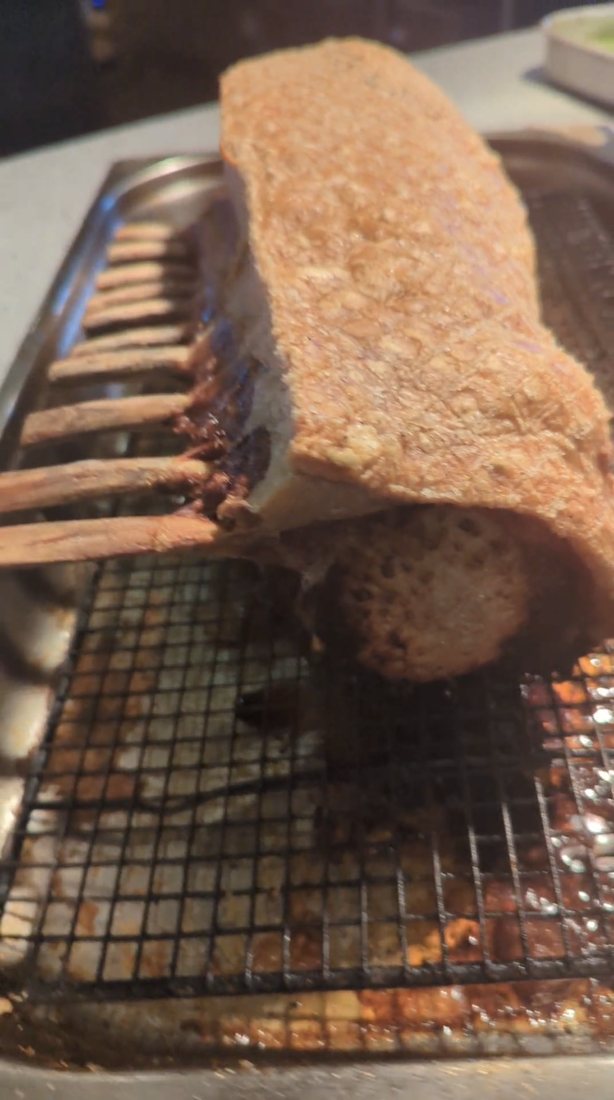
- The skin, rendered into crackling. Thirty portions of garnish that cost you nothing.
- Two front shoulders, seamed into muscle groups and trimmed into 8oz steaks — brined first, carved after cooking. Twenty to thirty of them.
- Two rear legs, seamed and diced, braised down for pie filling. Around thirty pies.
- The head, braised for brawn, then rolled into croquettes. Fifteen portions.
- Offal and all the trim, into faggots. Ten portions.
Nothing is thrown away. That's not a sentiment about respecting the animal, though it is that too — it's the commercial point, and it's the one that gets missed.
The comparison that matters
Here's where the usual argument gets weaker than people expect.
Buying those same cuts in, portioned, runs to somewhere around £11 a kilo at the time of writing — and pork has been climbing. For 50 to 65kg, that's £550 to £715 against £450 for the pig. So on the meat alone, breaking down a whole carcass saves you perhaps £100 to £250 — roughly a day of skilled labour.
On that arithmetic it's close to break-even, and anyone telling you whole-carcass butchery is a straightforward saving hasn't costed the hours.
The gain is somewhere else.
You get the parts nobody sells you. Skin, head, offal, bones, trim. Nobody is portioning those into a delivery, and they account for four dishes on the list above — around £390 of menu revenue that simply doesn't exist if you buy in.
And you get dishes nobody else has. Coppa you cured yourself. Brawn croquettes. Faggots made from your own trim. None of that is on a supplier's list, which means you're not competing on the same menu as every other pub within ten miles. That's worth more than the margin, and it's much harder to copy.
What you actually need
This is the part I'd want to read before starting.
Skill, and time to build it. Seaming a shoulder into its muscle groups is not difficult once you've done it a few times. It is slow and frustrating at first. The learning curve is real, and it costs more than hours: every chop cut badly is a chop you can't sell, and a shoulder seamed carelessly leaves saleable meat on the bone. The revenue figures above assume competence. Early on they won't hold, and that gap is part of the price of learning.
It's also work that has to be enjoyed to be done well. You can put someone on a shoulder every week, but nobody gets quick at a job they're merely tolerating — the skill builds in whoever finds it interesting, and that's worth knowing when you decide who does it.
Planning, above everything. You cannot put a whole pig on the menu at once. Sixteen chops, thirty pies and thirty charcuterie plates will not shift in the same week, and a menu that tries reads as a pig you're trying to get rid of. You're planning across months: chops and pies now, porchetta next week, coppa in three months. That's a different way of writing a menu, and it's the hardest part to learn.
Storage. Freezer and fridge space for a carcass you've just broken down. Curing needs its own space with controlled temperature and humidity — not a corner of the walk-in.
Paperwork. Curing meat needs documented HACCP, and depending on what you're doing and where, local authority sign-off. Worth a conversation with your EHO before you buy the pig rather than after.
A supply route. Best through a farmer who sends to an abattoir for you, rather than a wholesaler. You want to know what you're getting and roughly when.
And the right room. This is the one nobody mentions. Brawn croquettes and faggots need customers who order them. In a kitchen where people come for burgers, half your pig doesn't sell, and the maths that looked good on paper turns into a freezer full of trim. Whole-carcass cooking suits a place where people arrive curious.
Is it worth it?
If you have the skill, the space and the kind of customers who order the interesting thing — yes, comfortably. Not mainly because of the margin, but because of what it lets you put on a menu that nobody else can.
If you're short of any of those, buying in portioned cuts is a perfectly good decision, and it's the honest answer more often than trade advice admits. You can build towards it: one shoulder a week, seamed properly, teaches a section chef more than any course. Start with the cut you already buy and learn to break it down.
The saving isn't the reason to do it. The menu is.
Steve Harley is a head chef with over fifteen years in professional kitchens, including two-rosette level, based in Southampton. He writes about restaurant technique for home cooks at PlatefulChef, and takes on recipe development and trade writing — details here.